Travel eSIMs have become one of the easiest ways to get online abroad: you buy a data plan in an app, scan a QR code and you're connected when you land. That leads to a common question: if you already have an eSIM, do you still need a VPN?
The short answer: they do different jobs. An eSIM gives you a connection. A VPN protects what you send over a connection. Here's how each works and when it makes sense to use both.
What an eSIM does
An eSIM is a digital SIM card built into your phone. A travel eSIM lets you buy a local or regional data plan without swapping a physical SIM.
What it gives you:
- Mobile data in the countries your plan covers
- No hunting for a SIM shop at the airport
- The option to keep your normal number active for calls and texts
What it doesn't do: an eSIM doesn't add any extra privacy. Your data travels over the mobile network like normal mobile data, and the network provider (and the eSIM company's partner networks) handle your traffic.
What a VPN does
A VPN creates an encrypted tunnel between your device and a VPN server. It works on top of any connection: an eSIM, your home SIM, hotel Wi-Fi or a café hotspot.
What it gives you:
- Encryption between your device and the VPN server
- Less visibility for the network you're on: the Wi-Fi owner or mobile provider can see that you're connected to a VPN, but not which sites you visit
- A consistent connection point, wherever you are
What it doesn't do: a VPN can't get you online by itself. It needs a working internet connection, which is where the eSIM comes in.
eSIM vs VPN side by side
| eSIM | VPN | |
|---|---|---|
| Main job | Gets you online abroad | Protects your traffic |
| Encrypts your browsing | No (beyond normal mobile network security) | Yes, to the VPN server |
| Works without another connection | Yes | No, it needs Wi-Fi or mobile data |
| Hides sites you visit from the network | No | Yes |
| Affects which country websites see | Sometimes (see below) | Yes, it shows the VPN server's location |
| Typical cost model | Data packs by country or region | Subscription |
Is mobile data safer than public Wi-Fi?
Generally, yes. On mobile data you're not sharing a local network with strangers the way you are on airport or hotel Wi-Fi, and fake hotspots aren't a risk. That's a real advantage of using an eSIM instead of public Wi-Fi.
But "safer" isn't the same as "private." Your mobile provider can still see which websites you look up, and with a travel eSIM that may include partner networks in other countries. A VPN keeps that information inside the encrypted tunnel.
If you do end up on public Wi-Fi during your trip, read our guide on whether airport and hotel Wi-Fi is safe.
Why your eSIM may show you in another country
Many travel eSIMs route your data through a partner network, sometimes in a different country from where you are. Websites then see an IP address from that country, which can lead to:
- Websites in the wrong language or currency
- Extra security checks when you sign in to your bank or work accounts
- Some services asking you to verify your identity
If this happens, check your eSIM provider's help pages, and let your bank know you're traveling.
When using both makes sense
Using an eSIM and a VPN together covers both sides: getting online and keeping your traffic private. It's especially useful when:
- You fall back to public Wi-Fi. Your eSIM data runs low, so you join hotel or airport Wi-Fi. A VPN protects you on those networks.
- You share your phone's connection. If your laptop uses your phone as a hotspot, a VPN on the laptop protects its traffic too.
- You want your connection to look consistent. Some people prefer to connect through a server near home while traveling. If you use work tools, check your employer's policy first.
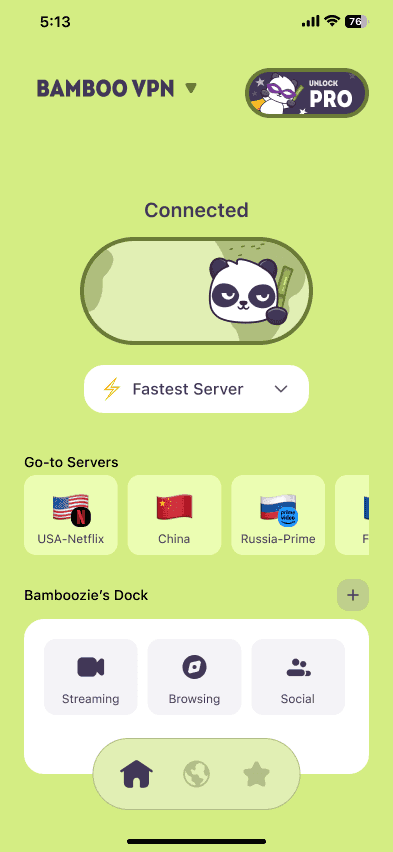
A VPN like BambooVPN runs on top of any eSIM or Wi-Fi connection, so you can keep the same protection as you move between networks.
Things to know before you go
- VPN rules differ by country. Some countries restrict or block VPNs, and in mainland China most VPNs are heavily restricted and unreliable. Check the rules for your destination before you travel.
- Encryption uses a little extra data. The overhead is usually small, typically a few percent, but keep it in mind on a small data plan.
- Install and test everything at home. Set up your eSIM and your VPN app before you leave, while you still have reliable internet.
Frequently asked questions
Do I need a VPN if I use an eSIM?
You don't need one to get online, but a VPN adds privacy an eSIM doesn't. It's most useful if you'll use any public Wi-Fi, share your connection, or want the networks you use to see less.
Does an eSIM hide my IP address or location?
Not on purpose. Some travel eSIMs route traffic through another country, so websites may see an IP address from there, but that's a side effect of how the network is set up, not a privacy feature.
Will a VPN use more of my eSIM data?
A little. Encryption adds a small overhead, usually a few percent. Streaming and large downloads use far more data than the VPN itself.
Can I use a VPN with any travel eSIM?
In most cases, yes. A VPN app works over any internet connection. If your VPN won't connect, try switching servers or protocols, and check that VPNs are allowed in the country you're in.
Are VPNs legal everywhere I travel?
No. VPNs are legal in most countries, but some restrict or ban them. Always check the local rules before you travel.
The bottom line
An eSIM and a VPN aren't competitors. The eSIM gets you connected; the VPN keeps that connection private. For most travelers, an eSIM plus a VPN set up before the trip is the simplest way to stay online and protected wherever you land.
Get BambooVPN for iPhone and iPad or Android before your next trip.
DOWNLOAD THE APP
THE INTERNET IS YOURS. UNLOCK.